
The Evolution of PAS 2035
The next iteration of the UK government’s retrofit standard comes into force at the end of March 2025. There are plenty of changes to be aware of, and it impacts all the key roles like Retrofit Assessor, Retrofit Coordinator and Retrofit Designer. Technical guidance has been updated, airtightness strategies are now included, and some compliance documents have become mandatory for all projects.
Due to a change in the qualification requirements, some Retrofit Coordinators may not be able to undertake the responsibilities they have been doing previously. The role of qualified, professional designers becomes more important, as do mandatory site visits for some installations. This takes some retrofit roles from merely desk-based compliance positions to those that require greater construction experience and how to deal with installers.


Due to a change in the PAS2035 qualification requirements, some Retrofit Coordinators may not be able to undertake the responsibilities they have been doing previously.
We see this as an opportunity to bring Architects and Technologists into the emerging retrofit market. The complexity of these projects demands expertise and the uptake of architects becoming Retrofit Coordinators has been slow. The scale of the opportunity is huge, including a newly announced £6.6 billion spend over 5 years for 5 million homes as part of the new Warm Homes Plan.
What is PAS 2035?
PAS 2035 Retrofitting dwellings for improved energy efficiency – Specification and guidance is the government’s retrofit standard. PAS stands for publicly available specification. It does not carry the same weight as a full British Standard. 2035 is simply the number – which can be seen as slightly misleading as it implies it has something to do with the year 2035, which it doesn’t.
The first iteration was PAS 2035:2019 but is due to be replaced shortly by PAS 2035:2023. As the name suggests, this was published in September 2023 with a transition period before it takes force on 30th March 2025.
The latest version had Dr Sarah Price as technical author supported by a steering group that included accreditation bodies like Trustmark & Elmhurst, government departments, professional consultants, housing groups, guarantee agencies and representatives of key players in the retrofit market.
The process outlined in this document is mandatory for all government funded retrofit schemes e.g. the Social Housing Decarbonisation Fund (SHDF), the Great British Insulation Scheme (GBIS) or ECO4 which is an energy company obligation to help improve UK dwellings.
For those working with private individuals in the ‘able-to-pay’ market, PAS 2035 is not mandatory. Still, many practitioners choose to use it wholly or in part as it preaches best practice and is hard to fault in its intentions to manage what is a complex process with many stakeholders. So, what does it do?
Each Home Counts Review
PAS 2035 was one of the outcomes from the 2016 Each Home Counts report, an independent review chaired by Peter Bonfield. Its purpose was to review the results of some poorly performing retrofit installations and recommend actions. These broadly covered restoring consumer trust & protection, the production of standards, and better monitoring and auditing of the retrofit process. The review highlighted the problem of unintended consequences and the lack of professional roles to support the customer on their journey with expert and independent advice. Too often the advice came from the same installer/ contractor with a vested interest.
The resulting PAS 2035 was published by the British Standards Institute (BSI) in June 2019. It is not a manual for how to retrofit a house, but a process, focussing on risk management involving the right professionals at the right time. It advocates for a Whole House Approach with a bias towards Fabric First measures. The key role of the Retrofit Coordinator is designed to be independent of any installers, so a customer gets impartial technical advice without that individual having an agenda to push any products.
Alongside this, Trustmark was established as a quality mark. This is a UK government quality assurance scheme that all retrofit professionals are accredited with (sometimes through a ‘Scheme Provider’ like a training organisation). Projects are also submitted to Trustmark’s Data Warehouse where they are audited for compliance and to check the qualifications and experience of the project team. Consumers are directed to Trustmark to find trades and professionals who are deemed to meet the required standard.
In summary, as the outcome of the Each Home Counts review, PAS 2035 is the whole house retrofit process that supports the customer from inception to completion, utilising the best industry advice with accountable and independent roles backed by recognised qualifications.

PAS 2035 Roles
The roles of Retrofit Assessor (RA), Retrofit Coordinator (RC), Retrofit Evaluator & Retrofit Designer (RD) were created by PAS 2035. For any existing construction professional looking to engage with the process, it is important to understand what your qualifications allow you to do, and which roles require further training.
Even chartered architects, surveyors and M&E engineers may still need to complete accredited retrofit or conservation training courses to satisfy all requirements of PAS 2035. Qualifications are checked during regular project audits, so there are no shortcuts. Crucially, these have changed between the 2019 and 2023 versions, which are explored in depth below.
Installation using PAS 2030
When the retrofit process reaches the construction stage (or Installation) then a different standard takes prominence. PAS 2030 Installation of energy efficiency measures in existing dwellings – Specification, covers the installation of energy efficiency measures (EEMs) like insulation, upgraded heating systems and renewables. It was first published in February 2012 and has been updated alongside the two issues of PAS 2035, such is their symbiosis. PAS 2030:2023 also comes into force on 30th March 2025 and supersedes any previous version.
Whereas the PAS 2035 process is audited by Trustmark and their external partners, PAS 2030 installations are audited separately, with their own training courses and certification to guarantee the organisations and individual tradesperson working on the project. Again, consumers are encouraged towards those who carry the PAS 2030 badge via Trustmark.
Individuals are required to sign off their work as part of a Claim of Compliance document. This is submitted to the RC as one of the key project documents, ensuring personal responsibility and transparency to the customer. The RC then submits this to Trustmark as part of the whole project submission, including the assessments and surveys from the RA, designs from the RD and the other documents that the RC is responsible for producing.

Risk Paths
One of the key aspects of PAS 2025:2019 was the risk assessment process that triaged projects into one of three paths A, B or C. Five criteria were used to assess the project and the overall risk path was assigned. These covered the number of properties being assessed, the number of EEMs being installed, construction type etc.
Path A was designated to the lowest risk where maybe only one measure was being proposed e.g. roof mounted solar panels that have no interactions with other parts of the house. Path B was the typical path used with Path C reserved for the highest risk covering lots of measures interacting combined perhaps with traditional construction with solid walls, or projects with heritage considerations.
The path determined which documents were needed, which qualifications were required by project personnel plus maybe extra roles. For example, Path C required a pre and post air test with certification. The path designation had an impact on the time, complexity and cost of the process for the client.
However, this is being simplified. All projects now follow a ‘main process’ more akin to the old Path B. Path A no longer exists so the simplest projects now require more documentation (like a mandatory Medium Term Plan). The project risk is now defined by building type, so additional steps may be needed for projects that are of traditional construction (e.g. pre cavity walls, solid stone) or protected, that are high rise or a system build. It is important this designation is defined early in the process so the project can be mapped out and the correct stages followed.
2025 Changes
The changes imposed by PAS 2035:2023 are numerous, so we’d recommend reading the new standard if full and following the guidance from your accreditation body if you are already practising in this field. For new projects, start using the new standard as soon as possible to avoid any submissions missing the deadline.
We have picked out some of the key changes below that will affect the process and the project roles undertaken by designers who also specialise as RAs, RCs or RDs.
Changes to the Roles
Retrofit Assessor
- Previously, a Path A project could be assessed by an RC. This is no longer permitted.
- All project assessments must be undertaken by an RA who is either qualified as a Domestic Energy Assessor (DEA) or a professional surveyor e.g. RICS.
- Additionally for traditional buildings, they must hold a Level 3 Award in Energy Efficiency for Older and Traditional Buildings (or Scottish/ Welsh equivalent). Proof must be provided to the RC for submission to Trustmark.
Retrofit Coordinator
- Previously, anyone trained to Level 5 Diploma in Retrofit Coordination and Risk Management (& accredited through Trustmark or a Scheme Provider) could undertake the RC role for all projects.
- Additionally for traditional buildings, they must now hold a Level 3 Award in Energy Efficiency for Older and Traditional Buildings (or Scottish/ Welsh equivalent), regardless of other professional qualifications like ARB or RIBA Conservation accreditation.
- The new PAS 2035 reduces the scope for the RC to automatically act as the RD.
Retrofit Designers
- Previously, an RD for a simple Path A project could be the RC (therefore a dual role), an MCIAT Architectural Technologist or a specialist designer / installer e.g. a solar panel installer.
- Previously, Path B could be an RC or professional (Architect, Architectural Technologist, Chartered Surveyor).
- Previously, Path C was as Path B plus with a Level 3 Award in Energy Efficiency for Older and Traditional Buildings or professional accredited conservation qualification e.g. RIBA Conservation Registrant.
- Under PAS 2035:2023 this changes:
- Single measures: must be a building professional (Architect, Architectural Technologist, Chartered Surveyor) OR specialist designer / installer. The RC can no longer be the designer unless also one of the above.
- Two or more interacting fabric measures: must be a building professional (as above) OR a quality assured specialist designer / installer (e.g. BBA certified). The RC can no longer be the designer unless also one of the above.
- Two or more non-interacting measures: a building professional (as above) or the RC.
- Any high-rise or system build with 2 or more interacting measures: a building professional (as above) only.
- Traditional building: a building professional (as above), plus a Level 3 Award in Energy Efficiency for Older and Traditional Buildings, or professionally accredited conservation qualification e.g. RIBA Conservation Registrant.
For anyone looking to maintain their current roles under the new version of PAS 2025, getting a Level 3 award is a good first step and many training providers offer this. This course covers the main differences between moisture open and moisture closed building fabric, the use of significance assessments and generally the greater care needed for dealing with these buildings. Some local authorities or regions offer funded places on these courses to encourage upskilling.
The biggest impact on the PAS 2035:2023 roles is the inability of Retrofit Coordinators to undertake project Retrofit Designer roles unless they have more widely recognised professional qualifications and skills.
Auditing under PAS 2035:2019 has shown that RCs too often take on the RD role for complex projects without the necessary skills to design and coordinate these interactions successfully. Some RCs have perhaps abused their ability to be the ‘jack of all trades’ of the retrofit process, taking on multiple roles and compromising the importance of their independence. These new rules reduce their scope in order to refocus on the customer and the quality of outcomes rather than filling every available project role.
For any professionals working in the architectural industry, this change in PAS 2035:2023 does allow a route into the retrofit sector as it recognises the qualifications, attention to detail and technical skills that people in these roles already possess. The change to the RD entry requirements will encourage greater collaboration with professionally qualified designers, presenting an opportunity for retrofit-minded Architects and Technologists. This leaves the RC to do their intended role of coordination, management of the documents, record keeping and advising the consumer with the support of their wider technical team.

Changes to the Process
- The new process tightens up (or adds) guidance around Significance Assessments, Heritage Impact Assessments, Air leakage Strategies and installer briefing ‘Toolbox Talks’ to help translate the design intent to the installation team.
- Expanding the scope of the Retrofit Assessment, so potentially more information for the RC to check and coordinate.
- Wider Retrofit Advice throughout the process, including potentially updating the Medium Term Plan (MTP) and Improvement Option Evaluation (IOE) rather than them being a static document.
- Greater focus on ventilation solutions and on-site checks, cross referenced to Building Regulations Part F.
- There is a greater emphasis on Fabric First and looking to address the ‘low hanging fruit’ before exploring more complex and expensive measures. This is on the basis that insulation measures have a longer life than say a heating system, which may be replaced 4 times within the life of a good insulation product. Trustmark are encouraging its external auditing partners to investigate why some RCs favour other measures before fabric, which could lead to more audit failures.
- Retrofit at Scale is one of the best ways to alleviate fuel poverty, but the old scheme tended to push these projects into Path C due to the large number of dwellings. The new process encourages technical assessment based on typologies or ‘dwelling types’ to help drive efficiency.
- Medium Term Plans are now mandatory for all projects. This document describes not only what is being installed now, but what could follow in future phases due to the expectation that few homes undergo one deep retrofit.
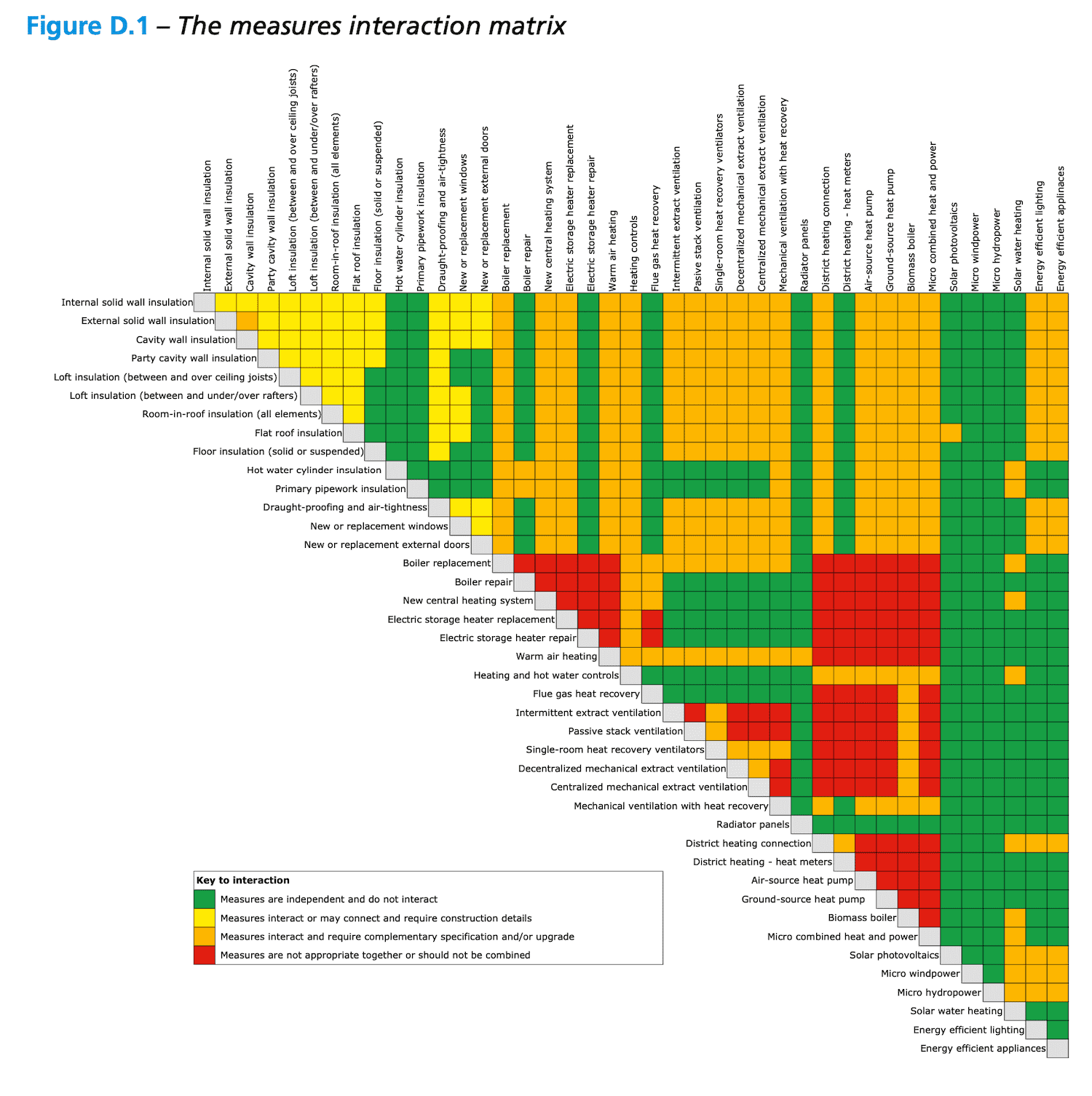
- ‘Concentrate on the interfaces’ is a key piece of advice to address the known heat loss and air leakage that occurs at the edges of walls to floors, windows to walls etc. This point is flagged primarily for the RDs to capture this in their details and specifications.
- The RC must complete in person Site Inspections for any projects with Flat Roof Insulation (FRI), Internal Wall Insulation (IWI), Room-in-roof Insulation (RIRI), External Wall Insulation (EWI), Underfloor Insulation (UFI) and Park Homes Insulation (PHI). For other measures, remote visits are possible including by a third-party colleague or associate. Consider this additional time as part of any fee quote.
- The RC must keep Site Visit Reports, recording greater digital evidence of the quality and progress from all inspections. As RCs are obliged to carry Professional Indemnity Insurance, this could affect PI renewal cover and costs. RCs not experienced in going to sites may need to acquire PPE and get themselves trained in basic site health & safety.
- Handover records must be kept for a period of six years or for the length of relevant warranties.
- Trustmark Lodgement Evidence – plans for tighter auditing of RCs digital evidence.
- Greater checks on subcontractors carrying insurance.
If you want to learn more about retrofit or the ways PAS 2035 can be used, download your copy free from BSi or through links on the Trustmark website. Organisations like the Retrofit Academy, Elmhurst or Quidos will provide training courses for those looking to undertake the L5 diploma or L3 award, as well as accreditation schemes onto the Trustmark portal where you can promote your expertise in retrofit.
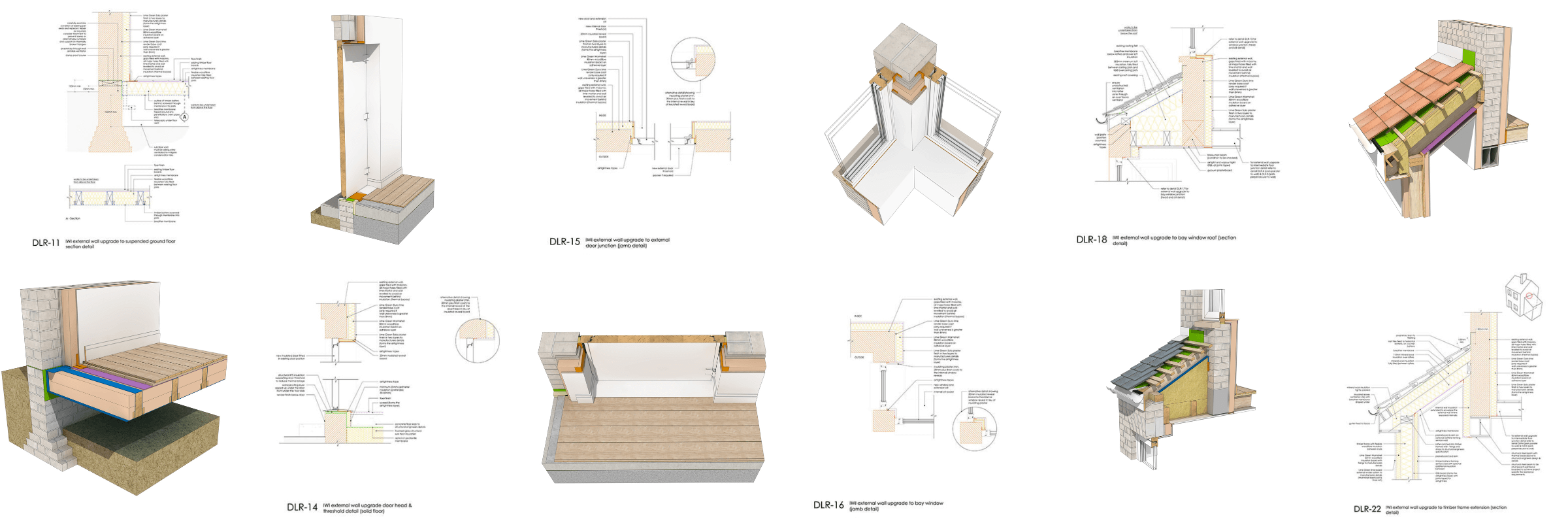
Here at Detail Library, we continue to grow our sets of technical retrofit details including thermal upgrades to walls, floors and roofs along with solutions to common problem areas like bay windows and door thresholds. We are dedicated to providing more technical content and guides for retrofit designers.
Resources
Related Reading

References and Useful Resources
BSI
Trustmark
https://www.trustmark.org.uk/business/information-guidance/pas-20352019-pas-203020352023
PAS2035:2023 Retrofit Design Guidance
https://cms.trustmark.org.uk/media/piamaow1/pas2035_2023-design-best-practice-guidance-final.pdf

Author
Written by Alex Bell, Retrofit Architect, Retrofit Coordinator and Passivhaus Designer with 25 years’ experience of design and construction. Alex practises low energy, sustainable design using the Passivhaus principles, EnerPHit or the PAS 2035 Retrofit approach.