
Starting Out in Sustainable Design
Now is an exciting time to dive into sustainable and low-energy design. With the growing urgency of the climate crisis and a renewed focus on improving building performance, there’s a wealth of knowledge, training, and tools available to help you design and deliver better buildings; whether new build or retrofit.
Starting out can feel overwhelming. There are so many courses, standards, materials and opinions. It’s hard to know where to begin. That’s why, for my first article for The Detail Library, I’ve pulled together a list of resources—courses, books, webinars, and guides—that I’ve found genuinely useful. These aren’t just theoretical: they’re practical, well-regarded in the industry and often led by professionals who have spent years working in sustainable construction.

You’ll find options here whether you want to get hands-on with building, dive into modelling tools like PHPP or learn how to upgrade historic homes without compromising their character. Many resources are affordable and offer member discounts. Grant funding is available in some areas. So whether you’re passionate about Passivhaus or just want to lower the carbon footprint of your next project, this guide is here to help you take the first step. My thanks goes to fellow architects Toby Smith, Alex Bell and Jenny Carlin for their contributions.
1: The Certified Passivhaus DesCertified Passivhaus Training qualification signers (CEPH) Course
I cannot think of a better place to get started than covering the CEPH course.
The course provides a structured and holistic introduction to Passivhaus. It equips you with everything you need to start designing low energy and Passivhaus Certified Buildings. That said, whilst it gives you the basic training, there is so much more to learn. Depending on the course, non-domestic, education, retrofit and multi-unit residential projects will be touched upon but not explored in detail. The Passivhaus Planning Package (PHPP), the tool designers use to analyse and optimise building performance, is also introduced but you will need to do more reading or training to confidently take on projects. Therefore, consider the CEPH course a starting point to Passivhaus and expect to do more training in your sector of interest.
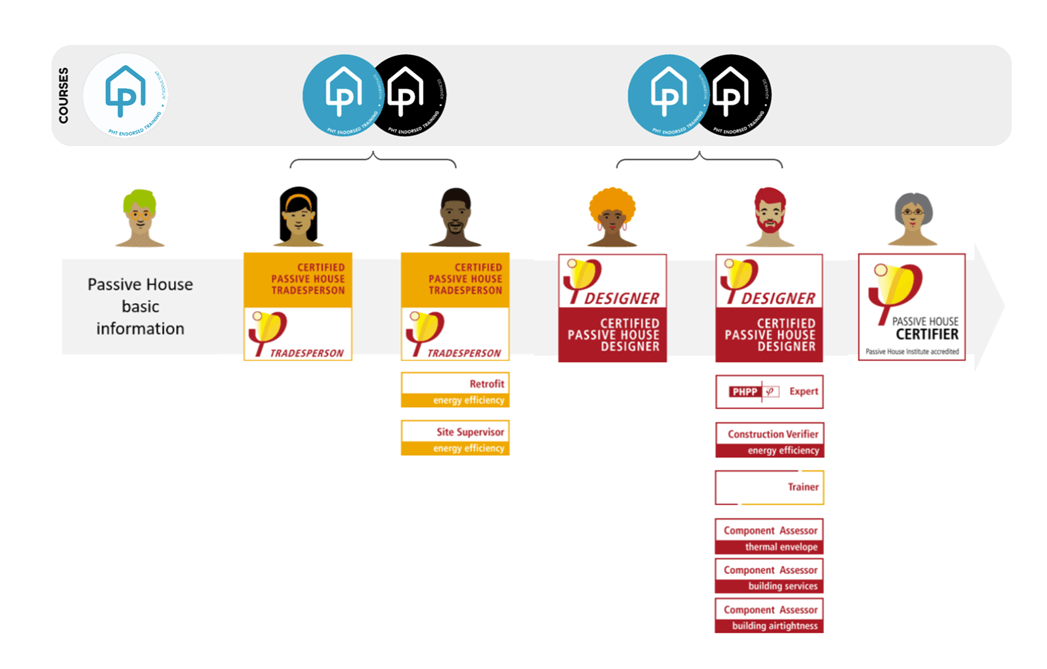
Each CEPH course covers the following areas:
- An overview of the core principles of the Passivhaus Standard.
- Designing buildings for performance: learning how form, insulation, airtightness, glazing placement and thermal bridging influences a building’s energy efficiency.
- Construction Methods: How different construction approaches can be used to meet the standard
- Overheating: Strategies to manage solar gain and internal heat loads
- Ventilation Principles: An introduction to designing and assessing Mechanical Ventilation with Heat Recovery (MVHR) systems. You will draw basic schematics of these as part of the exam.
- Services: Energy generation, heating systems and hot water systems.
- PHPP: An introduction to the Passivhaus Planning Package (PHPP)
- The Passivhaus Designer/Consultant role: The responsibilities, workflows, and collaboration required to deliver certified Passivhaus projects.
- Certification: The course ends with an opportunity to qualify as a Certified Passivhaus Designer via a 3hr ‘open book’ exam. This is an optional extra and many choose to do the course and not do the exam. That said, I would personally recommend it as a great way to cement your learning.

The course is excellent. However, it is intense, especially if you are also working full time. It is around 1x week of training; either as one block of time or split into sections. Exam preparation takes a few weeks of evening and weekend revision. Some providers, such as Coaction, have structured the course to suit professionals and make the learning as easy to balance with life as possible. My advice is to take a look at all the providers in the UK (all listed below) and see what course fits your working patterns best.
The cost of the course is around £2200+VAT at the time of writing. That said, many of the organisations listed below offer substantial discounts to members who apply to the course. You can also get funding to do the course from Local Authorities depending on what part of the country you are in.
At the time of writing, all UK Passivhaus Designer course providers are:
- Coaction Training CIC PL1 3RJ Plymouth, United Kingdom
- Oxford Passivhaus / Jandausch, Dieter OX2 9AJ Oxford, United Kingdom
- Passitherm Ltd. FK10 1QQ Alloa, United Kingdom
- South West College BT79 7AH Omagh, United Kingdom
- BRE WD25 9XX Watford, United Kingdom
- University of Greenwich SE9 2PQ London, United Kingdom
- University of Strathclyde G1 2TB Glasgow, United Kingdom
- Whole House Energy LLP NR4 7TJ Norwich, United Kingdom
A comprehensive list of courses worldwide can be found here.
If you are interested in building, rather than design, I suggest looking at the Certified Tradesperson qualification. This practical course is for individuals who want to build a Passivhaus instead of designing one.

2: Getting Started with Retrofit
The CEPH course explains principles that can be applied to both new build properties and retrofit. However, retrofit projects come with a host of common risks that need to be understood and mitigated against: particularly around moisture risk management, sequencing robust air tightness details and spatial planning of ventilation systems.
A good place to start is the Green Register’s ‘Retrofitting Traditional Buildings’ course. Led by Nicholas Heath, this course explores how to responsibly upgrade traditional and historic buildings for energy efficiency while preserving their character and managing risk. Through practical case studies and technical insights, the course equips professionals to navigate complex retrofit challenges, from planning and moisture management to airtightness and materials. Ideal for those working with older buildings, it promotes a whole-building approach rooted in the principles of context, coherence and caution.
I did this course a few years ago and really enjoyed it. There are a range of other online courses available from well established providers. These include:
- The Green Register Retrofit Skills Level 2 Course: The Green Register’s hybrid (online and practical) ABBE‑accredited qualification tailored for contractors, tradespeople, architects, and homeowners eager to enhance skills in sustainable retrofit.
- The UK Passivhaus Trust Retrofit Lecture Series: A learning on-demand course that explores retrofit for solid and cavity wall construction, multi-unit residential and non-domestic retrofit.
- Coaction Retrofit Delivery: specifically tailored for contractors and installers, but is also valuable for retrofit coordinators, assessors and design professionals.
- The AECB CarbonLite Retrofit Foundation: A comprehensive online self-taught course on whole building domestic retrofit. Suitable for construction professionals and technically orientated.
- For those who wish to go one step further and project manage retrofits professionally, you could explore becoming a retrofit coordinator by completing a Level 5 Diploma Retrofit Coordination Course. Options for this include the AECB Carbonlite Retrofit Coordination Course and the Retrofit Academy Retrofit Coordination and Risk Management Course.
3: Online Webinars: The AECB, The Green Register, UK Passivhaus Trust, Coaction and The International Passivhaus Association
The Passivhaus and retrofit community is underpinned by a strong culture of collaboration. The diversity of construction types, building typologies and climates in the UK alone would take several careers to master. No individual has all the answers. However, we have a passionate community of professionals who give their time for our collective benefit. The best place to access this wealth of information is through online webinars.
These are commonly one hour long and broadcast online over a lunch hour. Webinars are informal, open and honest. There is usually a (very busy) Q&A session at the end for individual issues to be raised and discussed. Great webinar platforms include:
- The AECB: The Association of Environmentally Conscious Buildings has an excellent library of past webinars (for members only; starting from £70/year for individuals). See this link for the list of upcoming webinars.
- The UK Passivhaus Trust: The online events from the UK Passivhaus Trust are well worth watching. A number of webinars have been packaged up into on-demand courses that explore a specific topic. The Large and Complex Passivhaus Masterclasses cover larger typologies including schools, leisure centres, multi unit residential and offices.
- Coaction has an excellent webinar series. Sign up to their newsletter for details of upcoming events.
- The Green Register has events covering airtightness, water use, retrofit, ventilation, construction standards and more
The International Passivhaus Association (iPHA) brings the global Passivhaus community together with Passivhaus case studies and lectures of the latest iPHA resources and tools

4: Books, Magazines and Guides
Yes, books and magazines still have a place in our digital world. Here’s a list of recent, and not-so-recent, reads I recommend for sustainability:
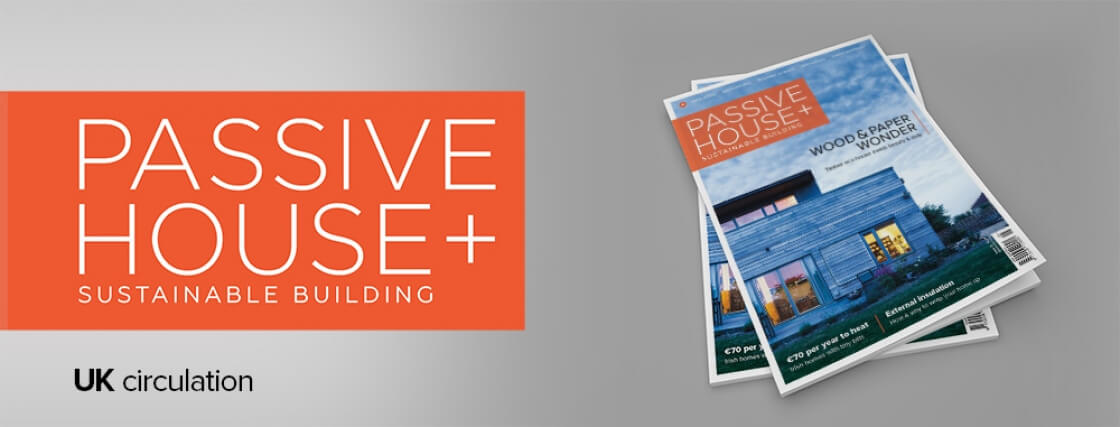
Passivhaus+ Magazine: Passivhaus+ Magazine has a mix of case study projects, products and industry news. Many readers keep their copies to refer back to; particularly for products to specify for future projects. I particularly enjoy reading the case studies that prove the Passivhaus standard does not result in dull or uninspiring design; such as this memorable wedge-shaped Passivhaus on an ‘impossible’ site. The Marketplace+ section of the website is worth looking at for products, consultants and installers. Membership of the AECB includes a digital subscription to Passivhaus+ Magazine.
PHPP Illustrated (Sarah Lewis): A handy guide to modelling in PHPP. An ideal starting point for getting to grips with the software. Very clear, excellent diagrams and ideal for single houses.
The ‘Without the Hot Air Series’. This series takes a step back and looks at the environmental movement at a societal and macro-economic level. I was first given ‘Sustainable Energy Without The Hot Air’ by David JC MacKay (free to access here) in my first year of architecture school and it has shaped my thinking around sustainability ever since. I also thoroughly recommend ‘Sustainable Materials without the Hot Air’ by Jullian Allwood et al. The wider series includes books on food, urban transport and drugs.
The Environmental Design Pocketbook (Sofie Pelsmakers): This is the ‘Architect’s Pocketbook’ for environmental design. Filled with diagrams, tools and practical tips, this resource simplifies complex technical data and regulations in an easy-to-use reference book.
Sustainable Renovation (Chris Morgan): Ideal for professionals across the sector—from architects and builders to policymakers and homeowners—it features detailed drawings, practical advice and thoughtful commentary that challenges conventional retrofit approaches. The updated second edition includes new content on climate adaptation, timber-framed walls, preparing homes for heat pumps and the broader challenge of scaling up retrofit efforts.
Understanding Passivhaus (Emma Walshaw): Our very own Emma Walshaw’s guide to Passivhaus detailing and design. If you like the Detail Library, you will like this book. I’ll take this opportunity to give a shout out to Emma’s other excellent technical guides on residential and commercial construction.
A number of manufacturers and suppliers have published practical guides and research on specific areas of retrofit. Below is a list of my favourites:
Ecological Building Systems supplies low energy building materials in the UK. They have published excellent articles on retrofitting specific areas of fabric, including floors and lofts, within the blog section of their website. Their technical team is on hand to answer any questions.
Mike Wye has over 30 years of traditional building and construction knowledge. Their guides cover lime plastering and cob repairs. Their CPD series covers a wider range of sustainability and low carbon topics.
Back to Earth is another building materials supplier with over 30 years of industry experience. Check out their Learning Lab for a wide range of technical guides using low carbon products.
Historic England has a library of research that includes energy upgrades to historic buildings. Take a look at the research section of their website here.
Detail Library: Check out our blog for a wide range of technical guides.
TRADA/Timber development UK (TDUK): For all things timber, Timber Development UK is a good place to start.
BS 5250:2021: For retrofit professionals, BS 5250:2021: Management of moisture in buildings. Code of practice is essential reading. This document addresses all phases of water (gas, liquid, and solid) and the interactions between them. It outlines the main sources of moisture in buildings, how moisture moves and accumulates, and offers recommendations and guidance for managing associated risks throughout the assessment, design, construction, and operation of buildings.
Building in Timber: Architects and developers are exploring how we can increase construction in CLT (Cross Laminated Timber), LVL (Laminated Veneer LLumber) and timber frame. One of the leaders in the field of Waugh Thistleton Architects. Take a look at their blog for research and insights.
5: PHPP – Places to learn

PHPP modelling is a cornerstone of Passivhaus. However, the day-to-day techniques for modelling buildings is only covered at a high level in the CEPH course. Learning how to model complex buildings, especially non-domestic buildings and components like curtain walling, requires further training.
Below are a few resources I have used over the years:
- PHPP Illustrated (Sarah Lewis): great for single houses
- The PHPP Manual: The software comes with a digital copy of the PHPP manual. It’s worth getting a hard copy for reference.
- Passivpedia: The Passivhaus resource
- The Passivhaus School: Online PHPP basic and advanced courses
- The AECB webinars with Tim Martel
- It is possible to become a certified PHPP expert by passing the PHPP Expert exam:

Join our community!
We’re at a turning point in how we build and live. Creating buildings that are low energy, resilient, and sustainable isn’t just a technical challenge; it’s a shared mission and one that needs a growing, diverse community of people who care.
Whether you’re on the tools, behind a desk, just starting out or bringing decades of experience, your skills and curiosity have a place here. The sustainability world is filled with people who are generous with their knowledge and eager to collaborate. There’s still so much to figure out and there’s real joy in doing it together.
So wherever you are on your journey, don’t be a stranger. Reach out to one of the organisations listed above, join a webinar, connect with others, and keep learning. The future of building is changing—and we’d love for you to be part of shaping it.
Related Reading

Author
Written by Rich Tyers, a sustainability-focused Architect and Passivhaus Designer with over 15 years of experience in environmentally responsible design and construction. His practice works on climate resilient retrofits, energy conscious homes and public sector projects.