
Fabric Upgrades and Heat Pumps – Finding the Sweet Spot
In March 2024, the National Audit Office (NAO) reported that heat pump uptake was slower than expected, despite the Boiler Upgrade Scheme (BUS) offering a £7,500 grant to replace an existing heating system with a new heat pump.
The target is 600,000 installs per year by 2028, which at the current pace is highly optimistic. One of the main blockers has been the cost to run a heat pump, not helped by a sceptical media that loves to promote the heat pump failures rather than celebrate the success stories.

This is not another article asking “are heat pumps good or bad?” They are good. Next question.
Nesta’s heat pump survey from May 2023 reported high levels of satisfaction overall from heat pump users across building types of all ages. Over 70% of respondents were either ‘very satisfied’ or ‘fairly satisfied’ with 8 of the 10 survey attributes (which covered things like running cost, noise, safety, ease of use etc.). Nearly three-quarters (73%) of heat pump users had the same or higher levels of satisfaction with their heat pump compared to their previous heating system.
So, this is not another article asking are heat pumps good or bad? They are good.
Next question.
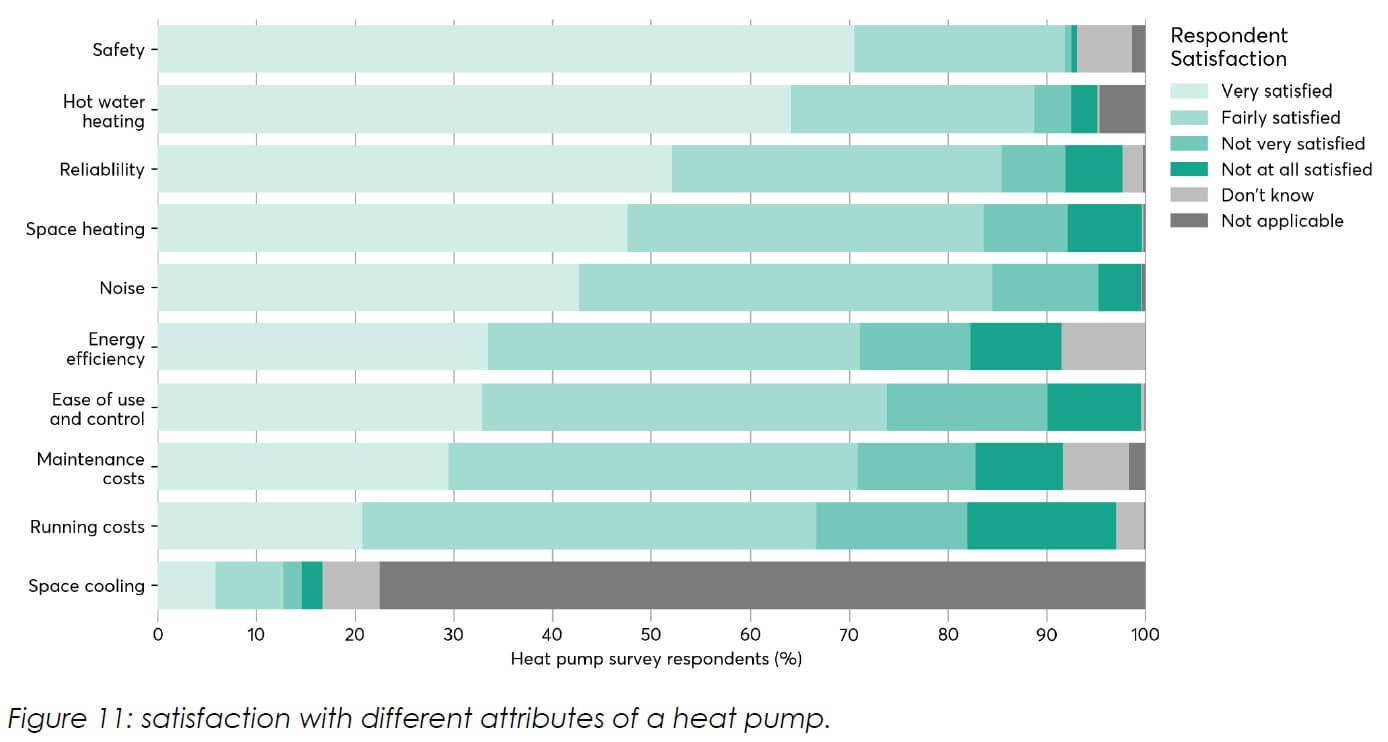
(Source: Nesta Heat Pumps: A User Survey May 2023)
Is a Heat Pump Right for My Home?
That is a better question, and the one that the retrofit industry is attempting to answer for curious homeowners across the UK. Many factors affect the successful switch to a heat pump including the existing pipework, radiator sizes, the hot water tank, external placement and noise. This article will look at the role fabric plays in the suitability of a heat pump including the current industry debates around Fabric First and Fabric Fifth.
In order to isolate the impact of the fabric, for this article we’ll assume in all scenarios that the heat pump is an air-to-water ‘air source’ and is well designed, installed and commissioned.
We have the coldest and leakiest homes in Europe and big problems with users experiencing discomfort. Many potential heat pump customers regretfully cite this as a reason they feel their home is not appropriate for a heat pump, as it is too cold and leaky. Poor fabric is not a technical barrier to installing a heat pump but will be a cause of poor performance. For most homes, some fabric upgrades are encouraged alongside a heat pump, but how much is enough? Where is the sweet spot?
Bespoke Solutions
Many retrofit professionals who support heat pump uptake prefer a tone that is positive but realistic. It is rarely straightforward, but in simple terms, a home running a boiler, hot water tank and wet radiator system can use a heat pump to do the same job. The answer is normally ‘yes, but…’
The architect/designer’s role will be to identify the fabric upgrades that will maximise the effectiveness of the switch, using insulation and airtightness measures to support the retention of heat and raise comfort levels. This comes down to good understanding of the home’s current performance, high-quality detailing and specification (using a Whole House Approach), focusing on the interactions as the main points of weakness. The growing collection of retrofit details in the Detail Library makes this job far easier.
Typical Energy Usage
For those motivated by carbon reductions, removing fossil fuels is the single most effective action you can take. The affordability of heat pumps in the UK is linked to the pricing of grid energy. Currently, one unit of gas is 4x cheaper than one unit of electricity. The government has committed to rebalancing this ‘spark gap’ which is seen as hampering moves to all-electric heating. There are wider issues around grid capacity too, but compared to mainland Europe, our electricity is disproportionately expensive and makes electric heating unattractive.
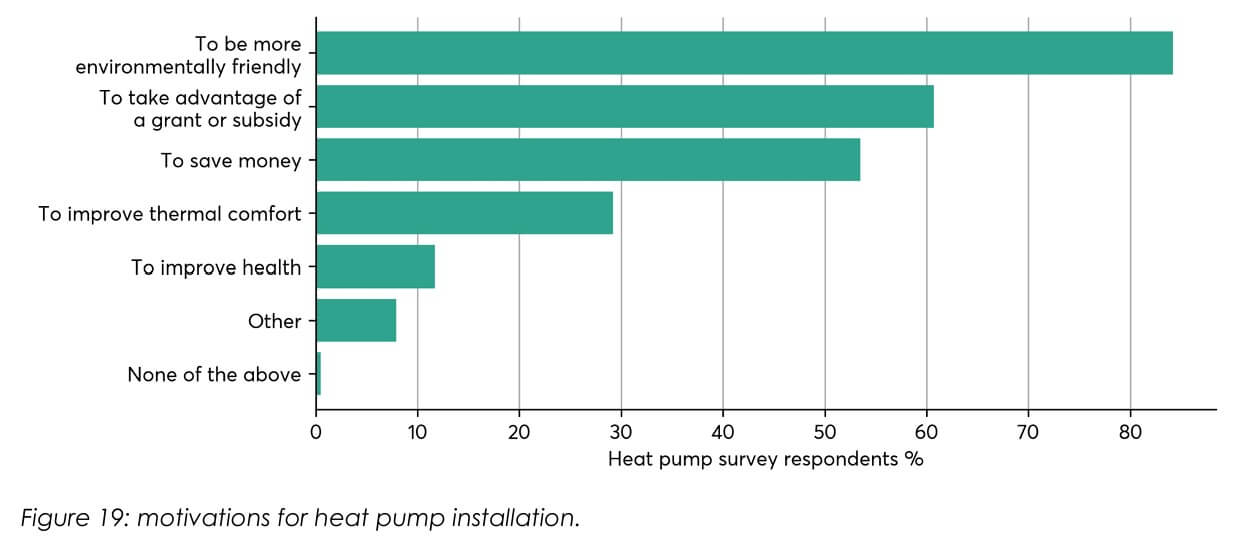
Nesta study motivations for installing a heat pump.
The way energy is explained to consumers is also mystifying, so it does not help them compare apples with apples when considering a shift in the way they manage their home’s energy.
Anyone who has bought or sold a house is familiar with an EPC certificate, giving the home an energy rating, like you find on whitegoods. EPCs currently still favour gas usage as the underlying calculation engine was designed to explain energy costs, particularly Primary Energy, which is fundamentally not the same energy metric that consumers see on their energy bills, which is delivered energy or ‘in-use’ energy. Currently, a move to heat pump may reduce your EPC score unless you do lots of fabric upgrades alongside it. Until the new calculation method arrives, this distorts the positive effects heat pumps make to home energy use.
Heat Demand
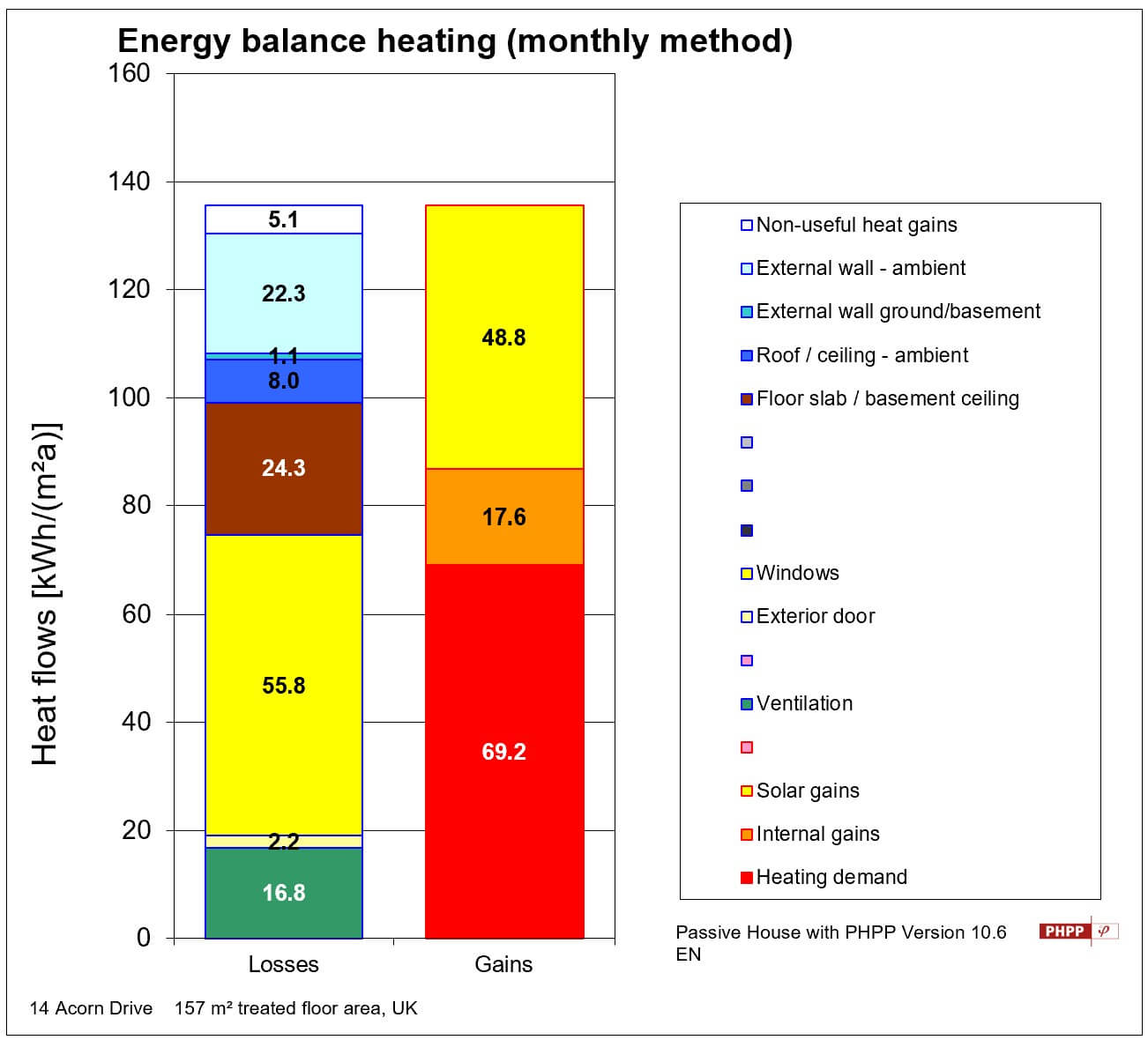
Note how the Losses and Gains are equalised by the large red block representing the heating demand supplied by the heating system
(Source: extract from a PHPP model)
We currently use our boilers to make up the deficit of heat in our homes. Imagine a big pair of scales, with gains and losses on either side. The heat gains include solar radiation through windows and heat generated by people, pets and appliances.
On the other side, the losses include heat escaping through the fabric, via ventilation and air leakage. For most UK homes of average thermal & airtight performance, the losses far outweigh the gains, so a high heating demand is needed to balance the scales.
For a typical home running a gas boiler, the space heating and hot water demand is the biggest proportion of overall energy use (c.80%). With the current ‘spark gap’, simply flipping a home’s fuel from gas to electricity will increase the bills by 4x. Ouch.
If that home has as efficient heat pump installed with a SCOP (Seasonal Coefficient of Performance) of 4 (= 400% efficient) then this levels it out again. Phew. But fundamentally the heat demand is still the same and the heat pump must produce a lot of energy to balance the scales from heat losses.
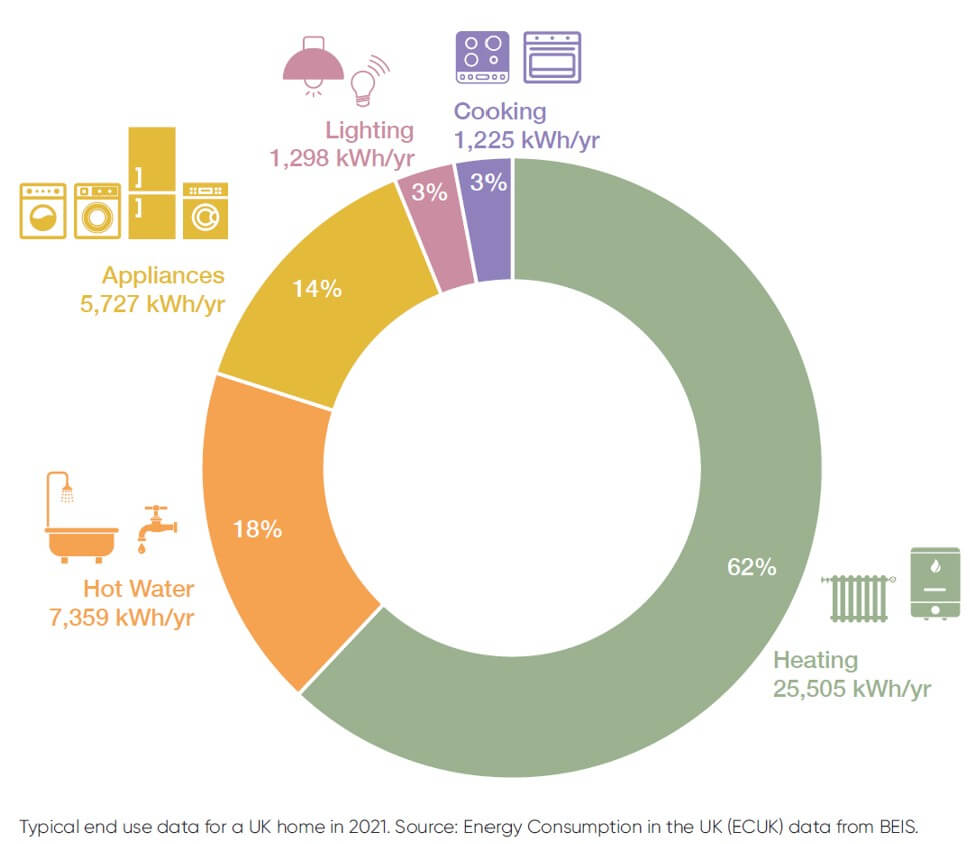
Devon CC Retrofit Guide Typical end use data for a UK home in 2021.
(Source: Energy Consumption in the UK (ECUK) data from BEIS)
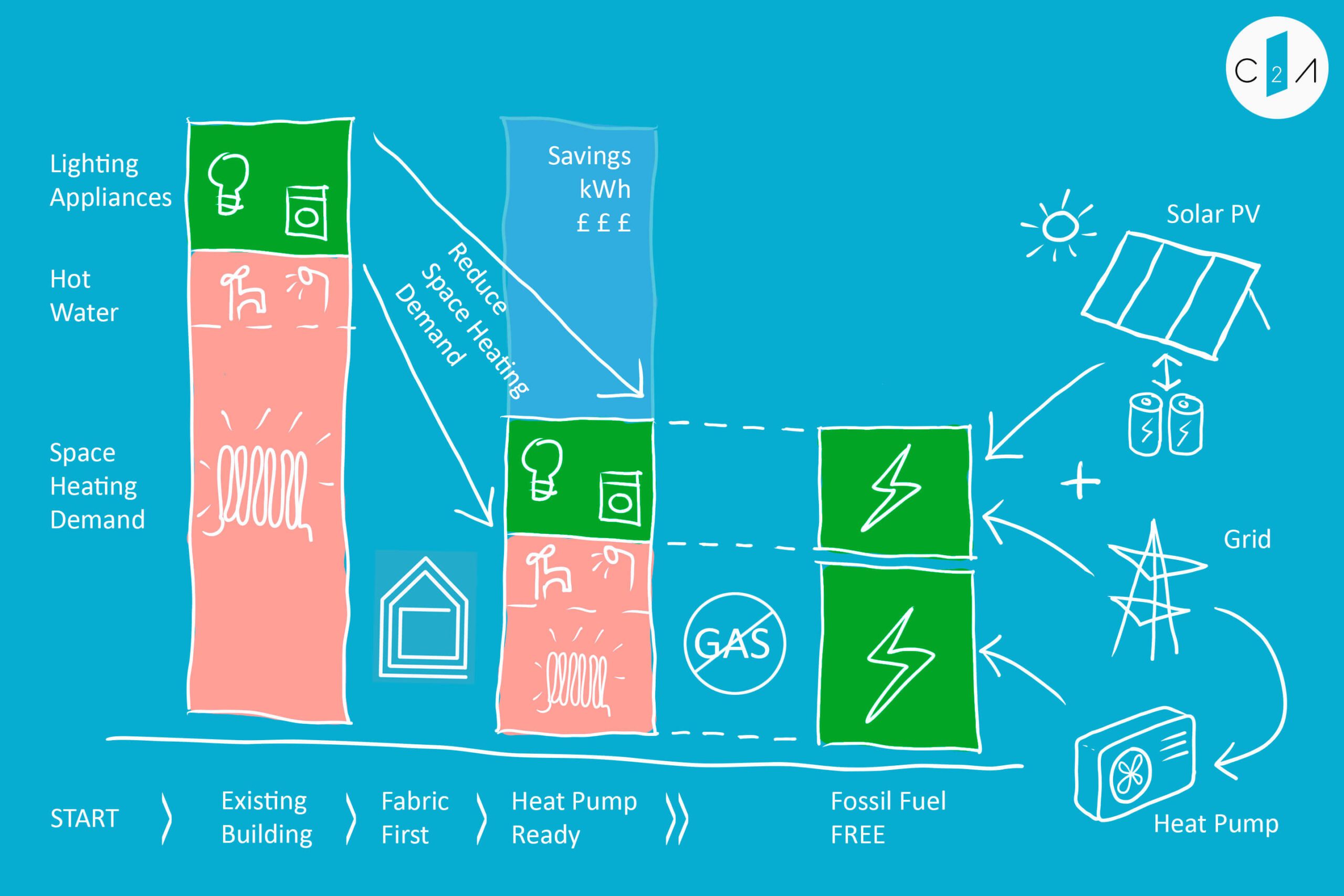
Using Fabric First to get a home heat pump ready and eventually, fossil fuel free. Chapter 2 Architects.
This is where Fabric First comes in: by increasing the performance of the building fabric, the heat we put in stays in, meaning fewer losses, reducing the energy demand.
The home’s next boiler or heat pump is smaller as it is required to cover a smaller heat balance deficit.
Fabric First
Fabric First is the best practice approach to Whole House retrofit that underpins PAS 2035, the UK government’s retrofit standard. In practice, this encourages insulation measures before technology, so loft insulation, cavity wall insulation and better windows are prioritised over solar PV and heat pump technology. PAS 2035 section 5.5 states:
“The existing building fabric should be as energy efficient as possible before spending resources on other measures. Subsequently, because insulation measures are generally among the most cost-effective and long‑lasting, and thus the best investment, insulation is usually the most appropriate next step. Insulating the fabric first also reduces the required capacity and cost of the heating system.”
Fabric First uses a 5-stage process, summarised as:
1) Undertake necessary repairs so you progress from a sound base,
2) Implement ‘low hanging fruit’ like energy efficient lightbulbs,
3) Use insulation upgrades to the fabric to improve thermal and airtightness values,
4) Hit the heating demand as efficiently as possible (which could include smart controls),
5) Use low or zero carbon technology like solar PV or heat pumps, but as a top-up on existing performance.
Note, this process should not be followed at all costs, and PAS 2035 recognises the need to say, replace a distressed heating systems or the constraints imposed by heritage.
Step 3 could be in multiple phases, so uses incremental improvements to the building’s insulation & airtightness reduces the heating demand before switching from cheaper gas to an electric heat pump. These steps are aiming to get the home ‘heat pump ready’ so there are fewer barriers and less physical disruption to installing a heat pump in the future.
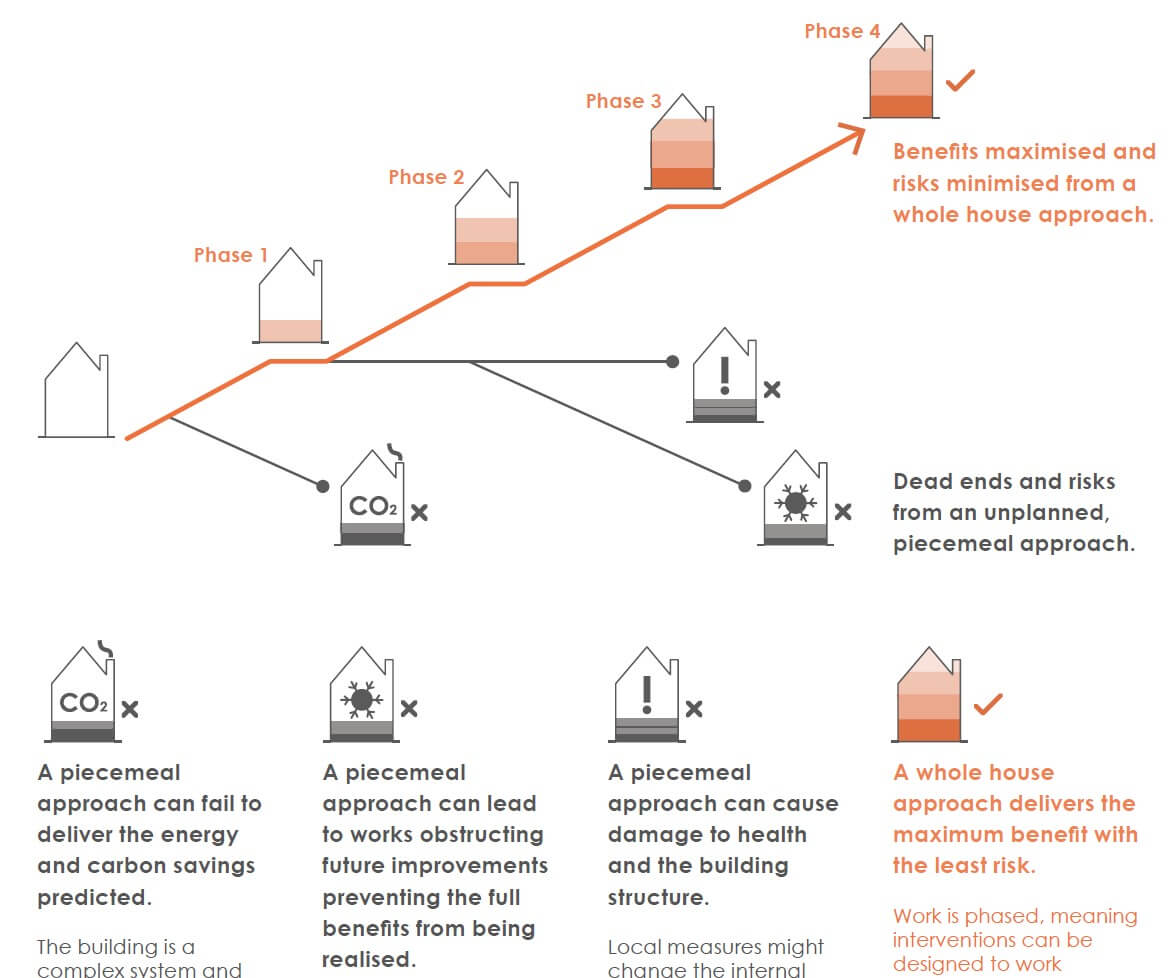
LETI Climate Emergency Retrofit Guide Fig. 5.1 Whole House Approach
The main thing counting against Fabric First is the low starting point of UK housing. If it takes 10 phases to get a home ready for a heat pump, that’s not only a passion-killer, but maybe means 5-10 more years pumping out carbon emissions from fossil fuels. Meanwhile, there’s still a skills shortage to deliver these millions of insulation upgrades and lack of finance options for private homeowners and landlords.
Fabric Fifth?
Nigel Banks, Technical Director – Low Bills and Zero Carbon at Octopus Energy provoked a few rounds of social media fisticuffs in 2023 when he dared to stand up and speak quite loudly in the retrofit quiet carriage. He said if saving carbon was the goal here, maybe we should start with the heat pump and follow on with the fabric measures: hence the birth of Fabric Fifth as an alternative strategy.
Nigel’s 5-stage manifesto can also be summarised as:
1) Install a heat pump using the BUS grant to vastly reduce emissions on day one,
2) Install a Smart Meter, Smart Controls and Smart Tariff to avoid peak charges and smooth off the effects of the ‘spark gap’ through efficient use of energy,
3) Increase comfort with draught proofing and simple energy saving tips,
4) Invest in solar PV and battery storage to support the all-electric home,
5) Major fabric insulation upgrades to walls, floors, roof, windows etc.
You’ll note that stage 3 is similar to Fabric First’s stage 2 ‘low hanging fruit’, and the major fabric upgrades are implemented last. Given how disruptive and costly these measures can be, it does beg the question will these things ever happen?
Explaining the early implementation challenges, Fabric Fifth suggests before the home is insulated enough for the best performing 400% heat pumps, they could run on higher temperature, lower efficiency heat pumps that are still all-electric and bring significant carbon savings over a gas boiler. Nigel’s article certainly did its job – to challenge the status quo.
Both these approaches assume you are in control, but what if your boiler breaks on Christmas Eve?
Proactive Planning
A key part of the decision making is also the age of your current boiler and how close to end of life it is. Hopefully, the remaining years can be used to prepare the home for its next low carbon heating source. Encouraging heat pump surveys now is a good way to establish what each home’s challenges are so homeowners can work towards being heat pump ready when they want to make the switch. This can also spread the cost.
If your current boiler dies before the home is ready, the path of least resistance is probably a new gas boiler, tying the home into 10 more years of high emissions. At a recent panel discussion about heat pump uptake at Futurebuild 2025, Kestrix CEO Lucy Lyons talked about ‘creating a funeral plan for your boiler’, which is an elegant way to describe how we must change our central heating purchases from reactive to proactive ones.
Your future heat pump needs planning and preparation. If running a combi, you’ll need space for a tank. If the radiators are small, they’ll likely need increasing in size to deliver the lower temperature heat over a larger surface area. If you’re putting gas-powered underfloor heating in the kitchen now, size it for a heat pump. Future proof every upgrade you make from this point forward.
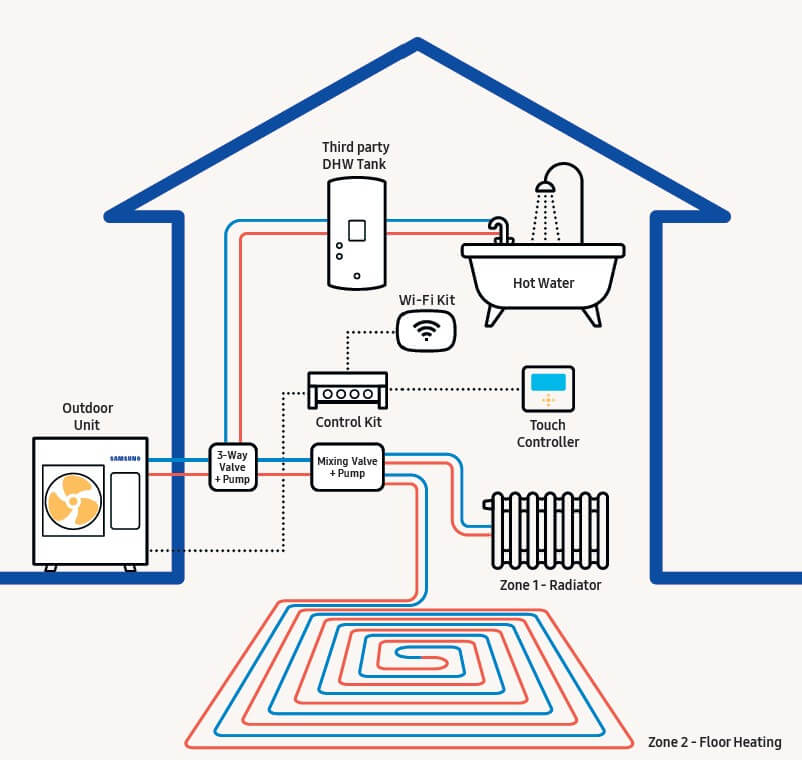
Diagram of the components for a heat pump central heating system.
(Source: Samsung Product Catalogue)
Easy Wins
Returning to the question of how much is enough, we can agree all sides are advocating for some fabric measures alongside the initial heat pump install (not forgetting good ventilation too). It just makes good sense to give the heat pump the best chance of success. These ‘easy wins’ or ‘low hanging fruit’ are often DIY tasks that are cheap to install and avoid the need for external contractors like:
- topping up loft insulation to 3-400mm,
- insulating & draught proofing the loft hatch,
- blocking up and venting open chimneys,
- letter box covers,
- brush seals around doors and windows,
- thick curtains across draughty porches,
- sealing waste pipes under sinks,
- taking out the cat flap in the back door when you don’t have a cat…
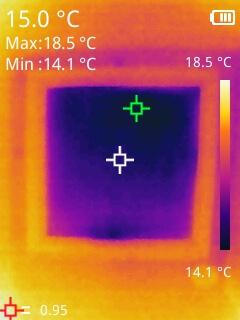
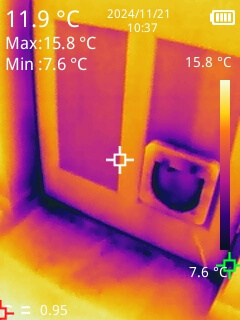
Thermal imaging shows the heat loss through an uninsulated loft hatch and around the base of a door and through a cat flap. Chapter 2 Architects.
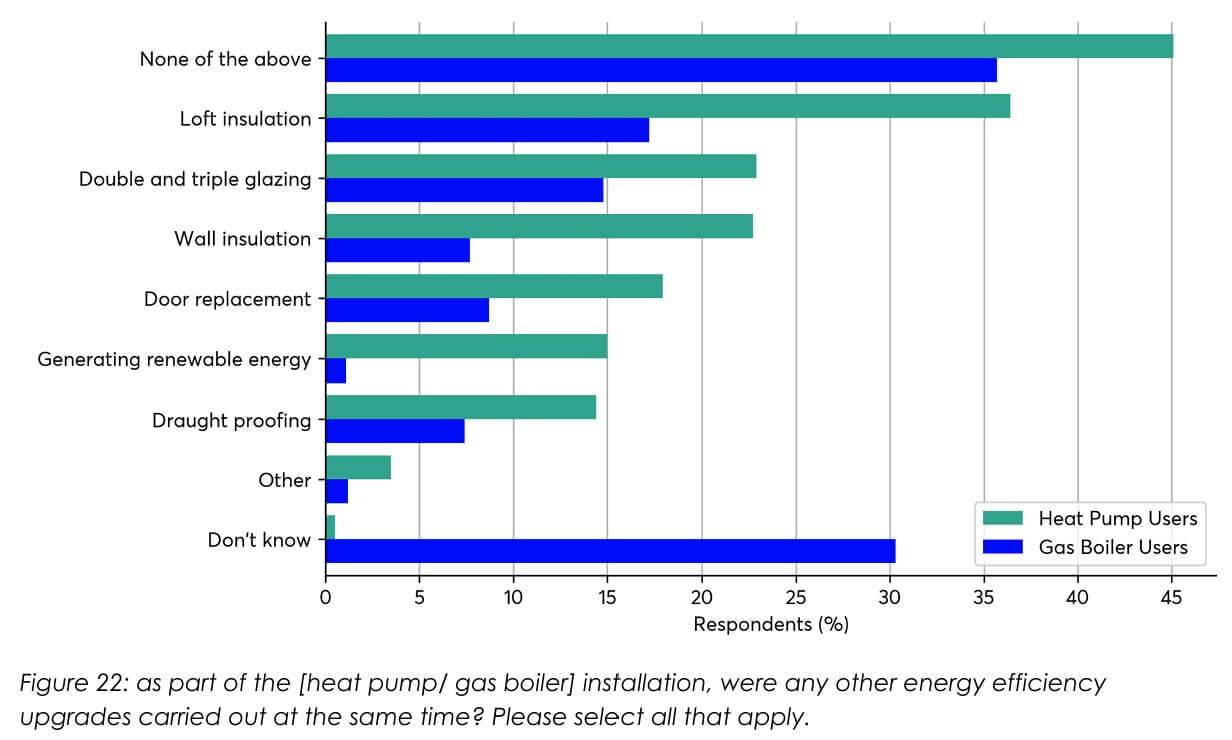
This is backed up by the Nesta study, which specifically captured data on which upgrades were undertaken alongside the heat pumps. It states,
“Over half (55%) of heat pump users had energy efficiency upgrades carried out at the same time as having their heat pump installed. The most common upgrade was loft insulation (36%) followed by wall insulation (23%) and double or triple glazing (23%). Fourteen percent of heat pump users upgraded all three of these common measures while 3% of users upgraded six measures.”
This statement goes further than just the easy wins and starts to address some of the big-ticket fabric items. This backs up the commonly held belief that some upgrades beyond the easy wins are required. Crucially, this doesn’t mean doing everything, as they also say:
“A relatively small proportion did multiple measures – 14%, for example, insulated walls and loft, and installed double or triple glazing.”
The sweet spot for the homes in this particular survey would appear to be somewhere between the easy wins and the full fabric upgrade. One could extrapolate that the high satisfaction levels of the new heat pump users were also influenced by the combined effect of the heat pump and the fabric upgrades working together to reduce costs and increase comfort.
Assessing the Options
When planning your fabric works, the level of improvement needn’t be a guess. With energy modelling, the reduction in heat demand could be easily estimated to promote evidence-based design. PAS 2035’s Improvement Option Evaluation stage uses this approach and requires customers be advised on five key metrics:
- capital cost of the measures (or packages of measures)
- lifetime fuel savings (e.g. reduction in bills),
- payback in years,
- lifetime carbon savings in CO2, and
- Carbon Cost Effectiveness – e.g. how expensive it is to save each tonne of carbon based on capital costs and the savings it generates.
Depending on the modelling techniques used, you may also be able to determine a reduction in overheating risk, increase in airtightness or expected internal temperatures.
Priorities and Motivations
When planning the stages of a retrofit use the customer’s motivations to direct your efforts, backed up by designs targeting property specific issues and modelled with high levels of certainty. Beyond the easy wins, you look to employ one or two of these targeted measures based on what you’ve learned:
- prioritising obvious weaknesses like single glazed windows and replace for double or triple glazing (where appropriate),
- ensuring cavity walls are performing as well as possible and where internal (IWI) or external wall insulation (EWI) can be employed alongside to boost the u-value,
- many older homes (pre-1980s) have windows placed forward of the cavity, creating very weak reveals, so thin IWI solutions can address this repeating cold bridge,
- alternatively, don’t miss the opportunity to install cavity closers alongside replacement windows, using high performance thermal fixings and air seal tapes.
- if window replacement is in a different phase to EWI, ensure the frames are thick enough that EWI can be returned to the frames to achieve thermal continuity,
- rear extensions often contain kitchens or bedrooms with 3 external walls, making them very hard to heat due to the high surface area. Focus on insulating these cold rooms in the shorter term where comfort benefits will be maximised,
- EWI is a great way to reduce heat loss from solid uninsulated floors pre-1980 by taking the insulation below ground level. Where limited options exist to increase the thermal performance of floors, doing this together with the walls makes the high upfront cost more palatable.
The resources here at Detail Library will make planning these upgrades far easier. Start with the current catalogue of solutions to manage those key interactions between windows, walls, floors and roofs. Consider future proofing junctions where the next phase may enhance the detail further. Your skill in applying these upgrades could make the difference in lower heat demand and higher heat pump performance, hitting that sweet spot for each project.
Resources
References and Further Reading
Leti Climate Emergency
Nesta Heat Pump Survey
https://www.nesta.org.uk/report/heat-pumps-a-user-survey/
Devon Retrofit Guide
https://www.energysavingdevon.org.uk/document/devon-retrofit-guide/
Elmhurst Energy
https://www.elmhurstenergy.co.uk/improvement-options-evaluator-software/

Author
Written by Alex Bell, Retrofit Architect, Retrofit Coordinator and Passivhaus Designer with 25 years’ experience of design and construction. Alex practises low energy, sustainable design using the Passivhaus principles, EnerPHit or the PAS 2035 Retrofit approach.
Image Credits
All credits as noted below images except image 01 – source: https://www.scottishpower.co.uk/air-source-heat-pumps